AI
Published : 17.03.2026
Imagine you are a study program manager, a lecturer or a R&D specialist wondering on the current needs and wishes of your partner companies. This article offers an answer in the context of the Ulysseus Joint Master’s Degree Programme AI for Business Transformation (UlysseusAI), as we share results from a survey conducted among our partners across Europe and North America. Results are limited to the partners that agreed on the use of their data for this purpose.
Company collaboration at the core of UlysseusAI
Ulysseus is a European University Alliance engaged in introducing interdisciplinary, forward-looking and creative degree programs to contribute to the sustainability and success of Europe. The alliance is committed to co-creating eight new joint master’s degrees connected to eight Innovation Hubs that are hosted by the partner institutions. Joint degrees mean study offerings that are offered together by several universities of the alliance and that are awarded by a joint diploma.
Working together with companies and other stakeholder groups is at the core of UlysseusAI, a degree programme focusing on artificial intelligence technologies and their sustainable adoption in organisations. Haaga-Helia UAS hosts and coordinates the Innovation Hub on Applied Artificial Intelligence for Business and Education, which calls for ongoing and consolidated collaboration between businesses, education, research, development, and innovation.
The overarching principle of innovation hubs is to encourage collaboration and to generate new ideas and creative solutions (Innovation Quarter 2022). In Ulysseus, Innovation Hubs and degree education benefit each other and share aligned goals. Various innovation hubs have been previously created around specific topics, such as cloud computing and services (Aunimo et al. 2021) and more generally around the idea of fostering entrepreneurship and innovation in an academic context (Innovation Quarter 2022).
Collaborators’ perceptions on the role of artificial intelligence
The development group of the UlysseusAI degree programme conducted the survey for its network of collaborators representing 29 different organizations, including
- 21 private companies,
- five government, state or municipality organizations (including higher education institutions),
- two non-governmental organizations and
- one association.
Diverse sectors and functions are represented, but the largest fields are information technology and research and development.
The participating organizations currently collaborate with members of the programme consortium, making them well-positioned to provide relevant and informed insights into the role of AI across sectors. They represent eight countries: Spain, Finland, Slovakia, Italy, Slovenia, Germany, Austria and Canada. Among respondents, there is an equal proportion of small, medium-sized and large companies. Most of the respondents are senior decision makers: half of them belong to the upper management and the majority are IT experts with over 20 years of experience.
We first asked for the respondent’s perceptions of the adoption of AI in their organizations. Most organizations stated that they are in the early stages of AI adoption, testing it or using it in limited ways. Seven organizations stated that they use it extensively or it is at the core of their business. This is mostly in line with the results of Eurostat, which state that 20 % of European enterprises use AI, and that 62 % of companies in the domain of Information and communication have adopted AI (Eurostat 2025).
Among our partners, AI is mainly applied in product or service innovation, process automation and optimization, and in business data analysis and visualization. Here the results differ from typical uses. According to Eurostat, the most typical use of AI is marketing and sales, whereas R&D and innovation activities only come in the sixth place (Eurostat 2026).
When it comes to the role employed by AI, most respondents perceive that it will have an increased role in their operations, ranging from just serving as an assistant or as a useful tool to being an integral and standalone part of their future operations giving them significant competitive advantage.
Over half of the respondents state that they face shortages of candidates when recruiting talent with adequate AI knowledge and skills, whilst six organizations state that they do not face shortages. The main skills the organizations are lacking are
- understanding of generative AI and its opportunities for business,
- skills for AI technologies automating workflows and assisting in decision-making and
- understanding of AI-relevant programming languages and software development.
The objectives of UlysseusAI are highly relevant
Wilson (2025) emphasizes the importance of relevant curricula to enhance and consolidate industry collaboration in higher education. Aunimo et al. (2021) highlight the role of company collaboration in curriculum creation especially in emerging fields where technology develops fast. Aunimo & Huttunen (2020) create and present a model in the context of education of AI technologies and cloud services (Aunimo et al. 2022). Along these lines, we asked the company respondents to evaluate the learning outcomes resulting from the objectives of the UlysseusAI programme.
The list below shows the main learning outcomes targeted in the UlysseusAI programme. They are listed according to their significance as perceived by the respondents of the survey. After each learning outcome, the average rating on a scale from 1 (not important) to 5 (highly important) as well as the variance in the responses is marked.
The lists shows that the respondents rate the skills related to identifying data sources and operation models that foster management support and create business value as most important. The least important skill according to the respondents is understanding the mathematical and statistical concepts behind the AI models. Interestingly, there is least disagreement on the importance of the learning outcome nr. 1, while the viewpoint on the significance of nr. 10 varies the most between informants.
Intended learning outcomes of the UlysseusAI programme
1. Identify and assess potential data sources and operation models for business development to foster management support and to create business value. (4,38; 0,53)
2. Demonstrate practical experience of using AI tools, platforms and frameworks for building AI based solutions by using AI programming languages and technologies such as image recognition, natural language processing and robotics. (4,34; 0,59)
3. Demonstrate skills in project management and team leadership, as well as in the ability to lead AI transformation projects. (4,10; 1,02)
4. Understand data and AI governance principles and management of AI development and implementation processes from the organisation’s executive (C-level) point of view. (4,07; 1,07)
5. Apply, evaluate, design and co-create AI products and services that are trustworthy, ethical and comply with European rules and regulations. (4,07; 1,21)
6. Implement the entire pipeline from large and complex raw data to visualizations or models, including the presentation of results in appropriate AI-driven user interfaces. (4,03; 0,82)
7. Integrate AI into business and public sector strategies and know how to assess the impact of AI initiatives in organizations. (4,03; 1,32)
8. Demonstrate skills for working in multicultural environments and international markets. (4,03; 0,68)
9. Understanding ethics, responsibility and sustainability (ERS) in applying AI. (3,97; 1,03)
10. Understand the mathematical and statistical concepts behind the building and evaluation of AI models. (3,62; 1,46)
Organizations are interested in academia-company collaboration
The survey included questions related to the degree of interest regarding various typical forms of academia-company collaborations. According to the results, most of the respondents are interested in offering short-term work opportunities to UlysseusAI students. According to Wilson (2025), it is indeed one of the most impactful ways of collaboration across industry and higher education institutions. The second most interesting form of collaboration is the possibility of networking with companies and universities involved in the degree programme.
The complete list of typical forms of academia-company collaboration is shown in Picture 1. It is ordered according to the interest shown by the respondents. The picture shows that 16 organisations are interested in offering an internship. Participating in study content development was perceived as the least interesting form of collaboration, with only 7 interested organizations.
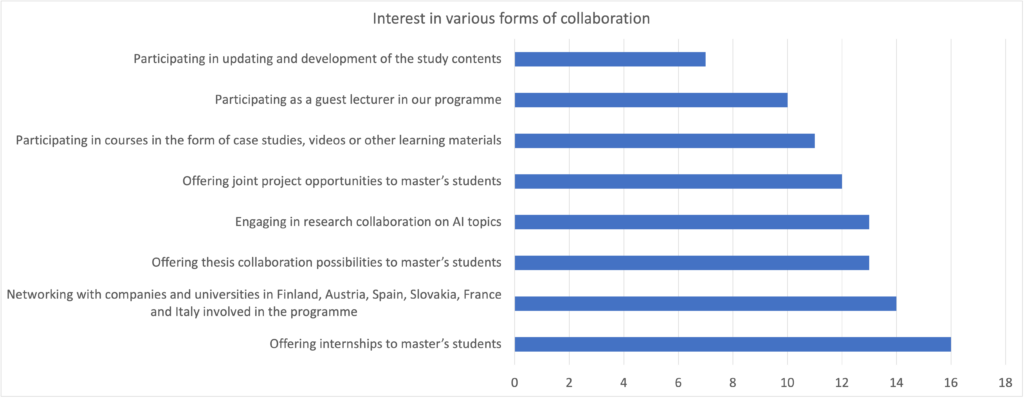
Picture 1: The interest shown by the respondents regarding typical forms of academia-company collaboration, ordered by perceived interest.
Company collaboration for the future
The UlysseusAI survey for the network of collaborating organizations shed light on the learning objectives that the potential employers of future graduates regard as important. This helps to guide the lecturers in their work on the continuous development of the curriculum.
The focus of interest of the potential employers was strongly in skills that bring added value to business and in practical skills required when developing AI driven applications. Sustainability, ethical issues and the mathematical foundations of AI were regarded less important by the respondents. When asked about the preferred forms of company-academia collaboration, offering internships for students was seen as the most interesting way of collaboration.
The results of the UlysseusAI survey will guide the development of the programme to make it respond even better to the needs of the job market and to serve the aims of its collaborators. The survey is an important part in the data used for developing the study programme – along with the data collected from students, lecturers and other university personnel.
UlysseusAI is the first European Joint Master’s Degree Programme of Haaga-Helia UAS and one of the eight Joint Master’s Degree Programmes to be developed in the Ulysseus European University Alliance. The first student cohort started in January 2025. UlysseusAI is an interdisciplinary programme of 120 ECTS created and delivered in cooperation with five partner institutions in the Ulysseus University Alliance, leading to a joint degree awarded by Haaga-Helia UAS and University of Seville: an MBA with the title Artificial Intelligence for Business Transformation.
Students have mandatory mobility semesters in Ulysseus partner institutions and may choose between two specialization options: a technologically oriented module at Technical University of Košice and a more interdisciplinary module at University of Seville.
The next application period for UlysseusAI will begin in August 2026.
References
Aunimo, L., & Huttunen, S. 2020. A model for building skills and knowledge needed in the job market. In INTED2020: 14th International Technology, Education and Development Conference. 2–4 March, 2020–Valencia, Spain. International Association of Technology Education and Development.
Aunimo, L., Hytönen, J., Ahola, H., Hokkanen, H., & Häkkinen, K. 2021. The DIHUB model for learning and innovating. In INTED2021 Proceedings (pp. 9993-9998). IATED.
Aunimo, L., Brkljacic, M., Lintilä, T., Camara, A., & Mrsic, L. 2022. Curriculum development for cloud services: answering the needs of the job market. In EDULEARN22 Proceedings (pp. 4197-4202). IATED.
Eurostat. 2026. Use of Artificial Intelligence in enterprises. Accessed: 16.3.2026.
Innovation Quarter. 2022. What is an Innovation hub? Accessed: 16.3.2026.
Wilson, B. 2022. Partnerships to make higher education work for the workforce. Times Higher Education, 28.7.2025. Accessed: 16.3.2026.
Picture: Haaga-Helia